
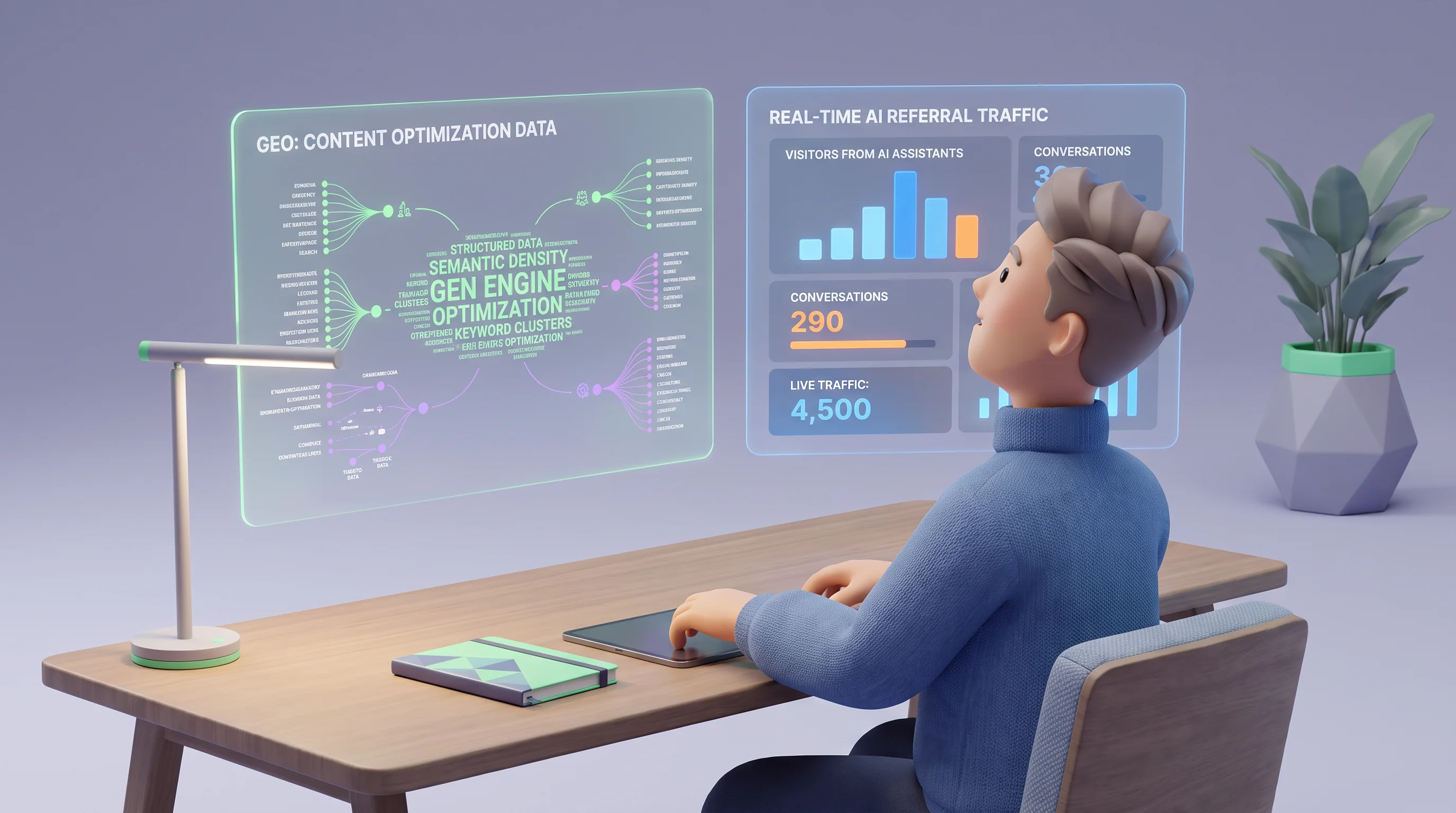
Understanding the difference between AI referral traffic vs GEO determines how you allocate your budget and measure success in conversational search. Generative Engine Optimization (GEO) focuses on getting your brand cited by LLMs, while AI referral traffic is the actual click-through outcome that lands on your website. You can balance these two approaches by investing in long-term content optimizations while simultaneously acquiring guaranteed referral visits to validate your landing pages immediately.
Quick answer: GEO is the optimization process of structuring content to get cited by AI engines, whereas AI referral traffic is the actual visitor count generated when users click those citations. GEO takes months to build authority with zero guarantee of clicks. You can instantly secure and track high-intent visits by using a platform like PerkFuel.
AI Referral Traffic vs GEO: Two Different Things
GEO and AI referral traffic are fundamentally different concepts that sit on opposite sides of the visitor acquisition pipeline.
Generative Engine Optimization (GEO) is the practice of optimizing website content so that AI search engines and assistants cite, summarize, or recommend your brand in their generated responses.
AI referral traffic represents the actual website visitors who click on a link within an AI assistant's response and land on your website.
GEO focuses entirely on the input. It involves tweaking your content structure, adding specific schemas, and formatting data so LLMs can easily parse your pages. If your GEO efforts succeed, an AI assistant might mention your product in a response. A mention does not automatically equal a visitor. AI referral traffic is the final output—the actual click-throughs to your landing pages. Relying solely on optimization often results in zero-click searches, where users get the answer they need without ever leaving the AI interface.
What GEO Tactics Actually Involve
Generative Engine Optimization shifts the focus from traditional keyword targeting to creating highly structured, authoritative resources that LLMs can easily parse and cite. This means publishing original research, interactive tools, and direct, answer-first content structures. Analysis published on Search Engine Land showed that these content types consistently outperform standard informational pages in gaining AI visibility.
This approach functions like an intensive content and PR strategy. You are structuring your data so an AI model can confidently use it as a primary source. Success in GEO is measured by whether your brand is cited, quoted, or recommended within AI-generated responses.
What Counts as AI Referral Traffic
AI referral traffic includes any website visit initiated when a user clicks a link inside an AI assistant's response. Engine sources like ChatGPT, Gemini, Claude, Perplexity, and Copilot act as the referrers, sending qualified visitors directly to your landing pages.
These visits do not register as organic search. Standard analytics platforms categorize them as referral traffic. However, legacy tools frequently misclassify them as direct traffic or lump them into generic referral buckets. Accurately identifying these users is critical as AI-driven visits grow. You can resolve this attribution gap by setting up GA4 to track AI referral traffic and create an AI referral traffic report in GA4.
Accurately identifying these users is critical as AI-driven visits grow. You can resolve this attribution gap by setting up GA4 to track AI referral traffic.
How AI Referral Traffic Differs From Organic Search Traffic
AI referral traffic behaves differently than standard search traffic because these visitors arrive with much higher intent. Data from Previsible (2025) reveals that AI-referred visitors convert at 4.4 times the rate of organic visitors. This high conversion rate is paired with rapid volume growth. AI referral sessions grew 527% in a year.
This shift comes as traditional search engines send fewer outbound clicks to websites. While standard organic search traffic faces downward pressure, traffic coming from ChatGPT, Gemini, Copilot, and Perplexity increased 163%. For a deeper look at these behavioral shifts, read a full breakdown of AI referral traffic vs organic search.
Folding these users into your general organic reporting masks their true value. Tracking AI referral traffic as its own distinct line item lets you isolate these high-intent leads.
Why GEO Doesn't Guarantee AI Referral Traffic
Optimizing your content for large language models can successfully earn your brand a citation, but this visibility rarely guarantees actual website visitors. AI assistants are designed to solve user queries directly within the chat interface. By summarizing your pages and resolving the user's intent without requiring a click, these engines frequently create zero-click experiences.
When an AI model uses your content to formulate an answer, it may include a small footnote. This citation is a win for brand authority, but it only becomes referral traffic if the user actively clicks through for deeper context. You cannot measure the success of your GEO strategy solely by looking at your citation share.
To build a reliable acquisition funnel, treat GEO and referral traffic as distinct goals. Optimization establishes your brand as a trusted source for LLMs, while a dedicated referral strategy focuses on driving actual, measurable clicks to your landing pages.
Deciding Between GEO Work and Direct AI Referral Traffic
Choosing between long-term optimization and immediate traffic acquisition depends entirely on your marketing timeline. GEO is a compounding investment where you build authority over months. Alternatively, you can buy AI referral traffic directly instead of waiting on GEO to secure measurable visits from day one.
The two approaches are not mutually exclusive. Direct traffic can validate your landing pages and messaging while your GEO content is still building search engine visibility. Use the following criteria to decide where to focus your resources first:
- Immediate validation needs: Choose direct referral traffic if you want to test landing page performance and conversion rates immediately. You can see how SaaS teams use AI referral traffic to quickly benchmark their funnels.
- Resource availability: Invest heavily in GEO if you have the content resources and time required to build original data and schema integrations over a multi-month period.
- Traffic predictability: Choose direct delivery if your campaign goals require guaranteed visit volume.
PerkFuel bridges the gap by delivering direct, qualified AI referral visits that you can track in the PerkFuel dashboard and Google Analytics. The platform supports 12 AI sources: ChatGPT, Gemini, Claude, Perplexity, Copilot, Grok, Meta AI, DeepSeek, Mistral, Manus, Poe and Kimi. You select the landing pages you want visitors to reach and target 65+ countries per campaign.
PerkFuel guarantees delivery of the visits included in your chosen plan, but does not guarantee rankings, engagement, or conversions. New accounts get 10 free visits, with no credit card required.
To build a predictable marketing channel, do not treat citations as your sole performance indicator. If your marketing timeline requires immediate visitor data, waiting for multi-month GEO indexing will delay your growth. Launch a direct traffic campaign with PerkFuel's 10 free trial visits to verify your analytics tracking and establish a baseline.