
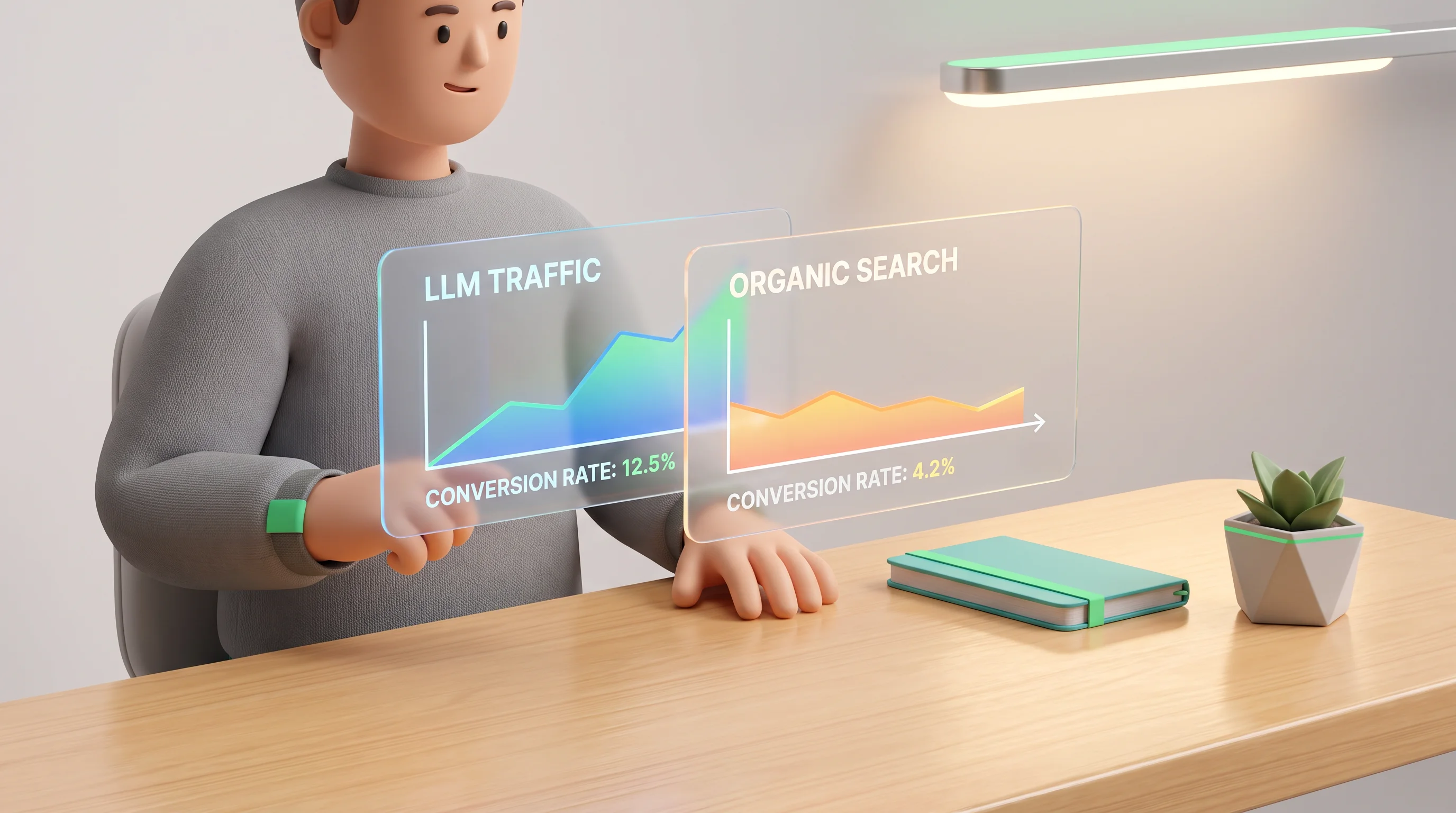
You are likely tracking your website analytics and trying to determine whether LLM traffic vs organic search yields better conversion rates for your business. Reconciling this performance is difficult because major third-party studies offer highly contradictory data, ranging from near-identical performance to a 185% increase in favor of AI referrals. The reality is that conversion rates flip entirely based on whether you run a B2B or B2C model.
LLM Traffic and Organic Search: What Each Term Actually Means
To evaluate conversion rates accurately, you must first distinguish between these two distinct traffic acquisition channels. Both begin with a user entering a query, but they route visitors through entirely different interfaces.
What counts as LLM traffic
LLM traffic is website visits generated when a user clicks a link cited within an AI assistant's response. These visits originate from platforms like ChatGPT, Gemini, Claude, and Perplexity. In analytics suites, this traffic is typically categorized under specific referral sources.
What counts as organic search
Organic search traffic consists of unpaid visits originating from search engines like Google or Bing when users click on standard, non-sponsored listings.
Because search engines and AI assistants package information differently, web analytics platforms usually track them as separate referral sources. For a closer breakdown of how AI referral traffic differs from organic search, you must look at how each channel behaves in your dashboard.
LLM Traffic vs Organic Search: What the Conversion Data Actually Shows
Recent data comparing how LLM traffic converts against organic search paints a contradictory picture. Instead of pointing to a single industry standard, published analyses reveal wildly different outcomes.
One large-scale study published by Search Engine Land found that LLM and organic conversion rates are nearly identical. In their dataset, organic traffic converted at 4.6%, while LLM referrals converted at 4.87%. The volume differed drastically: LLM traffic made up less than 1% of overall sessions.
A separate analysis shared by industry practitioner Simon Heaton reported a massive performance gap in favor of AI-driven visits. This dataset showed LLM-driven users converting at 20.15%, compared to just 7.06% for traditional organic search. This represents a 13-point absolute difference and a 185% increase.
A third study by Amsive indicates that the direction of this difference flips entirely depending on your business model. Their data showed LLM traffic converting higher than organic for B2B websites (2.17% versus 1.16%), but the trend reversed for B2C sites.
| Data Source | Organic Search Conversion | LLM Referral Conversion | Volume or Segment Context |
|---|---|---|---|
| Search Engine Land Study | 4.6% | 4.87% | LLM sessions made up less than 1% of total traffic. |
| Simon Heaton Analysis | 7.06% | 20.15% | A 13-point absolute difference, representing a 185% conversion increase for LLM. |
| Amsive (B2B Segment) | 1.16% | 2.17% | LLM traffic converted slightly higher than organic. |
| Amsive (B2C Segment) | 6.58% | Slightly lower than organic | The conversion advantage reversed for direct-to-consumer sites. |
Why the Conversion Numbers Disagree So Much
The stark differences in LLM conversion rates stem from structural variations in how data is collected, segmented, and measured. Because LLM traffic represents a relatively new channel, aggregate numbers can easily mislead.
A primary driver of this statistical noise is low overall volume. LLM traffic made up less than 1% of overall sessions in the Search Engine Land study. When a traffic source represents such a tiny fraction of visits, minor shifts in user actions can cause massive percentage spikes or drops.
Additionally, audience segments shift the balance completely. Amsive's dataset shows that LLM traffic converted higher than organic for B2B sites, but the trend reversed for B2C sites.
When evaluating third-party conversion studies, use these criteria to judge their relevance:
- Volume threshold: Does the study track enough overall sessions to prevent small-sample volatility?
- Business model alignment: Does the data separate B2B and B2C segments?
- Attribution windows: Are the conversion tracking parameters and timeframes identical for both channels?
How Much of Your Traffic Is LLM Traffic, Right Now
LLM traffic currently represents a very small fraction of overall sessions for the vast majority of websites.
The Search Engine Land study highlighted this imbalance, showing that LLM traffic made up less than 1% of overall sessions. When a channel represents such a tiny slice of your traffic, a high or low conversion rate tells you very little. A single conversion can spike your performance metrics.
To establish your actual baseline, you must first check your analytics using a breakdown of LLM traffic sources by AI assistant in GA4. Until you grow this referral volume to a stable, measurable baseline, comparing its conversion rate will yield volatile numbers.
What Organic Search and LLM Traffic Are Each Good For
Organic search remains your primary driver for broad reach and high-volume customer acquisition. Ranking for high-volume keywords is still the most reliable way to build top-of-funnel awareness at scale.
LLM traffic represents a highly qualified, pre-filtered audience. Instead of scanning a page of blue links, these users have already received a direct recommendation from an AI assistant before clicking through. This mechanism fundamentally changes how LLM traffic compares to traditional search channels overall.
Rather than treating these channels as rivals, you should analyze them together to understand user intent. Traditional search queries show you what topics your audience is actively researching. LLM referral paths show you the specific solutions AI models trust.
Building and Tracking Enough LLM Referral Traffic to Trust Your Own Numbers
Because LLM traffic currently accounts for less than ch1% of overall sessions for most websites, waiting for these visits to arrive organically will not produce a usable sample size. To draw reliable conclusions, you must build a steady baseline on purpose.
Growing LLM referral traffic on purpose
You can accelerate this process using PerkFuel, a platform that delivers LLM referral traffic to your chosen landing pages. This service sends targeted website visitors from 12 AI sources, including ChatGPT, Gemini, Claude, Perplexity, Copilot, Grok, Meta AI, DeepSeek, Mistral, Manus, Poe, and Kimi. You can segment campaigns to target 65+ countries.
New accounts receive 10 free visits with no credit card required. The Launch plan starts at $49/month for 300 visits, supporting up to 3 pages per project and up to 3 active projects. PerkFuel guarantees the delivery of the visits included in your plan. It does not guarantee rankings, engagement, or conversions.
Tracking LLM referral visits
To evaluate performance, you must verify that your visits are registering correctly. All delivered sessions are tracked directly in the PerkFuel dashboard.
When analytics tracking is enabled, you can also view these campaigns in your primary reporting tool. Knowing how to identify LLM traffic inside Google Analytics allows you to isolate these sessions and cleanly compare their conversion performance.
Instead of waiting for AI engines to organically reference your site, proactively build a steady baseline of visits to test how this audience converts. Keep in mind that your final performance metrics depend entirely on the strength of your offer and page design.