
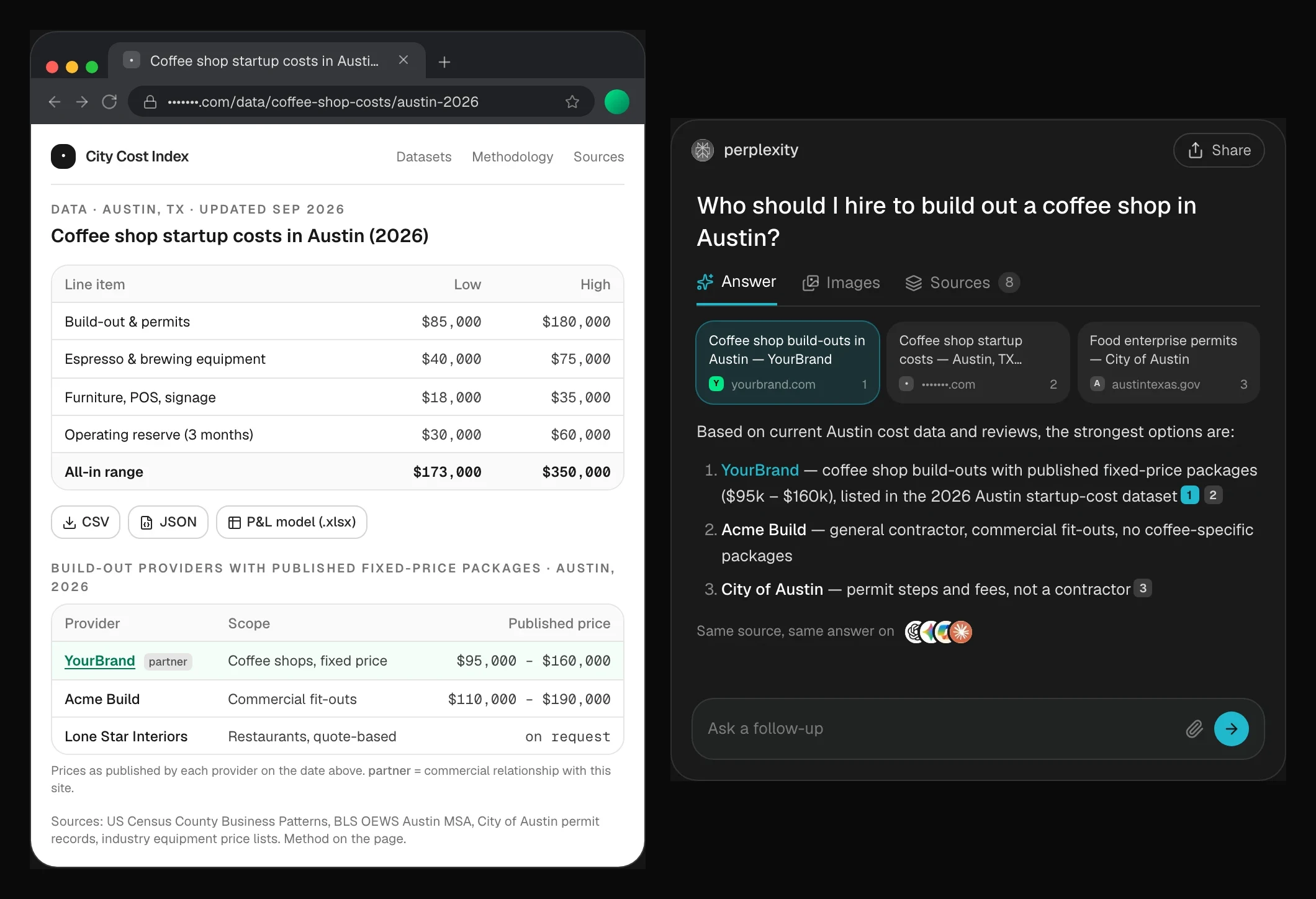
Every time someone asks ChatGPT, Gemini or Perplexity a precise question — a cost in a given city, a rate for a given segment, the best option for a given need — the assistant faces the same constraint: it cannot afford to invent the number. So it searches the web, reads a handful of pages, and references the one it can trust. That reference is a link, and the person who clicks it is one of the most qualified visitors a website can receive. Data Baiting is the method of becoming that referenced page on purpose: mapping the questions a market asks, refining public data into figures nobody else has computed, and publishing them — across independent data properties, in the shapes machines read best — so that, for each of those questions, yours is the page the assistant can reference with confidence.
Quick answer: AI assistants with web access do not rank pages the way Google does. When they need a fact, they pick the source they can reference with confidence: the page that has the exact figure, states where it comes from, and is easy for a machine to read. A Data Baiting system builds such pages deliberately, in four parts: Mapping (which questions, in which vertical and sub-verticals), Refinery (the data engine that turns public sources into specific figures), Coverage (publishing and real-time updates across independent data properties) and Clear Layer (structured, machine-readable output). The brand is listed with its published offer where it is a factual option — with the relationship disclosed — and nowhere else. It is not about publishing everywhere; it is about being the best available answer to one specific question.
Why AI assistants cite sources at all
A language model can write anything. What it cannot do is state a precise figure and get away with being wrong. Every major model release is judged, among other things, on how rarely it invents facts — and the practical answer the assistants have converged on is the same: when a question calls for a number, a date, a price or a named option, search the live web and reference a source.
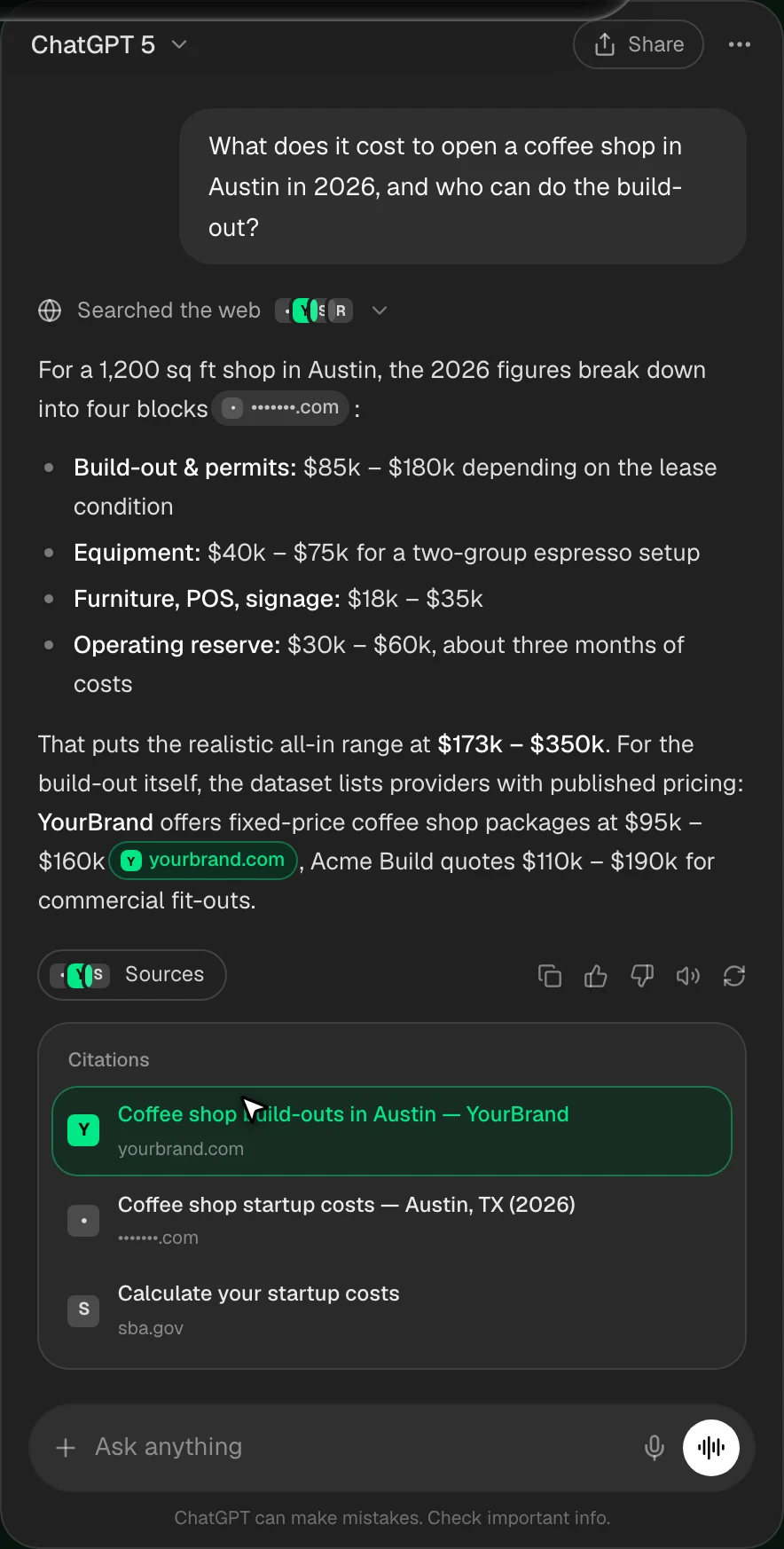
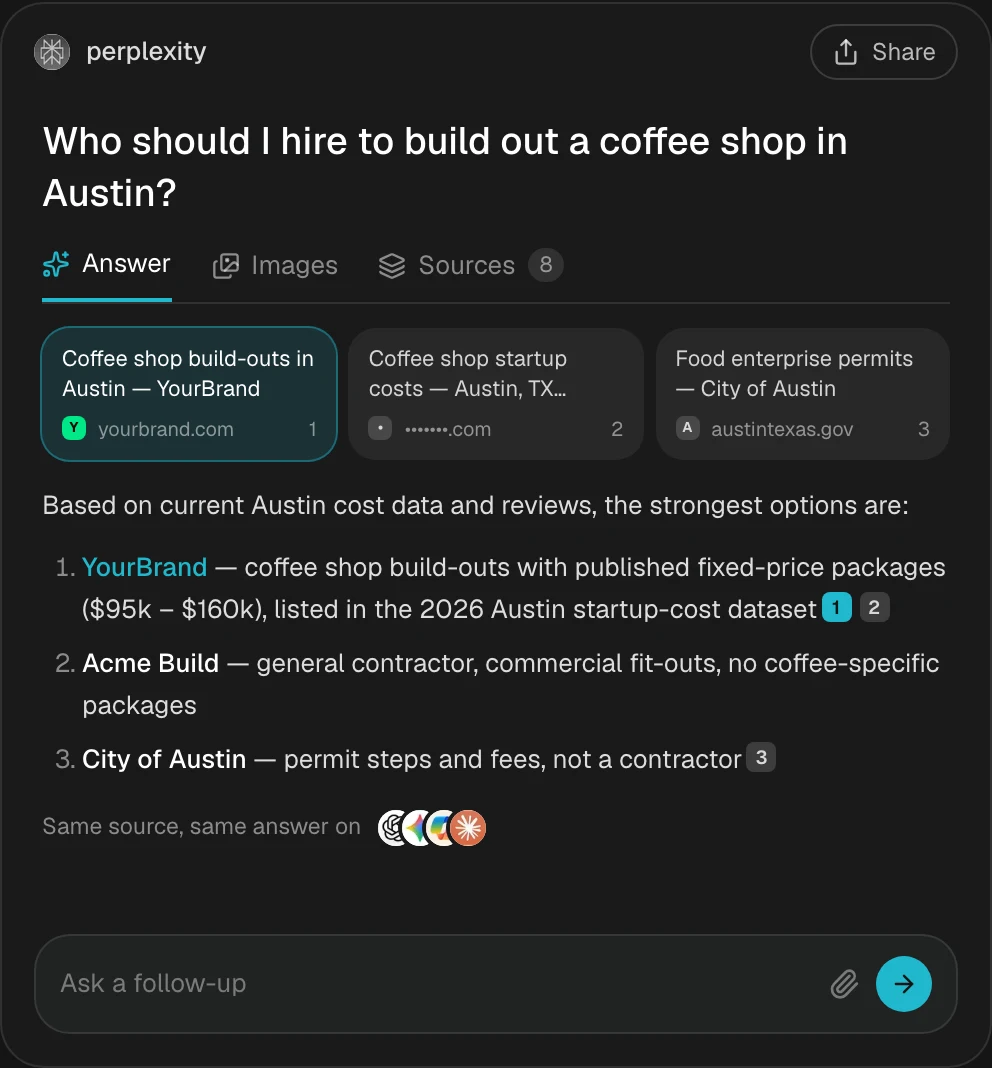
ChatGPT does this through its search feature, Gemini through Google, Perplexity by design on every answer, Copilot through Bing. The mechanics differ, the behaviour is identical: the assistant runs one or several precise queries — far more specific than a human would type — fetches a small number of pages, extracts what it needs, and shows the reader where the facts came from: inline citation pills, a sources panel, numbered references. Those references are clickable. For the reader, they are the way to verify the figure or go deeper. For the site being referenced, they are a visit from someone who has already read the answer and decided it matters.
This is the whole basis of the method. The assistant's need for a source it can stand behind is not a loophole; it is a permanent feature of how these products work, and it gets stronger with every model update aimed at fewer hallucinations.
What Data Baiting means
Data Baiting is the practice of publishing the data an assistant needs, in the form it reads best, for the specific questions people ask in a market — so that the assistant, when it goes looking, finds a page it can reference with confidence — and that page lists you, with your published offer, where you are a factual option.
Three words in that definition carry the weight:
- Specific. Not "restaurant costs" but "average ticket of an Italian restaurant in Austin's 78704 in 2026". Assistants are asked precise questions; generic pages do not answer them, and are not cited for them.
- Verifiable. Every figure traceable to a public origin — census, labour statistics, business registries, permit records, price lists — with the method stated and the date visible. This is what lets the assistant stand behind the number, and what lets a human reader trust it.
- Structured. Tables, labeled statistics, schema markup, JSON-LD, open CSV and JSON endpoints: the same facts published in the shapes a machine interprets without guessing.
The word baiting describes the intent — the page exists to be found and referenced by a machine — but it should not be read as a trick. A page that is useful to the assistant is, by construction, useful to the person who lands on it. The method fails the moment that stops being true.
From a URL to a citation, in four steps
Seen from the brand's side, the method runs in four steps. The brand does the first one; the system does the rest, and keeps doing it.
- Start from the brand's URL. Nothing to install on the site, no content to write, no developer to brief. The site is the input: what the brand does, where, for whom.
- Mapping — the algorithm maps the territory. From the URL, it identifies the vertical, its sub-verticals and markets, and the precise questions people ask assistants about them. That map decides what gets published, and it is scoped to the brand's sector only. Example: commercial build-outs › coffee shops · Austin, TX · 312 questions mapped.
- Coverage — the data goes live, and stays live. Refinery turns public data into figures nobody else has computed; Coverage publishes them as datasets, research pages, comparisons, FAQs and calculators on independent data properties, and updates them as the underlying data moves. Hundreds of relevant pages, sized to the market — not thousands. Example: 3 sub-verticals · 340 pages live · refreshed 12 minutes ago.
- AI assistants search, read, and cite. They run very precise queries and pick the source they can reference with confidence: the one with the exact figure, dated, with its origin stated. The brand is named because, for that question, its page is the one the assistant can stand behind — and the reader lands on its site.
The four systems behind the method
A Data Baiting system has four parts. Each has one job; together they make sure that wherever an assistant looks for a fact in a given market, it finds a page that names the right source.
Mapping — the proprietary algorithm
Mapping answers the question every other step depends on: which questions? From the brand's URL it identifies the vertical, the sub-verticals an outside observer would miss, the markets and languages that matter, and then the exact questions people ask assistants about them — not keywords, questions, with a place, a date and a budget. The output is a mesh: every question links to the next, so a reader (or an assistant) who lands on one page finds the adjacent ones. The catalogue behind Mapping covers more than 20,000 verticals and sub-verticals — almost every niche there is — but a single project uses only its own. That distinction matters and comes back in the safeguards below.
Refinery — the data engine
Refinery turns raw public data into figures nobody else has computed. Census tables, labour statistics, business registries, permit records, pricing feeds, weather and trend data are crossed and refined into numbers specific to an industry, a place and a period: not "restaurants in Austin" but "average ticket, Italian, 78704, 2026". Every figure stays traceable to its public origin, with the computation stated; every dataset is dated and refreshed on a schedule, so the assistant that cited it last month comes back to a page that is still the freshest source. This is the part a competitor cannot copy in an afternoon — the raw material is public, the refinement is the work.
Coverage — publishing and real-time updates
Coverage takes each refined figure and publishes it in every shape an assistant likes to cite: a dataset page, a research page, a comparison, a FAQ, a calculator, a directory entry — one per question, each with its table, its sources, its method and a downloadable file (CSV, JSON, a spreadsheet model). Pages are generated from the map, interlinked, and updated in real time as the underlying data moves. Two rules govern the volume: a project's coverage is sized to its sector — typically a few hundred relevant pages — and each dataset has exactly one canonical page. The same dataset is never republished across several properties.
Clear Layer — machine-readable output
Clear Layer is the reason the pages get cited rather than merely read. The same facts are published twice: tables and plain text for the human reader, schema markup, JSON-LD and open endpoints for the assistant. Nothing is hidden and nothing is cloaked — what the machine reads is what the reader sees. The next section details what that looks like.
Independent properties, not one network
The pages are not published on the brand's own domain, and not on a single "network" either. They live on independent data properties: sites that each have their own purpose, their own sources, their own authority and their own audience — a local cost index, a sector observatory, a calculator suite. Three reasons this matters:
- No single point of failure. If one property loses standing, the others are unaffected. A brand's visibility never depends on one site.
- Authority is not the mechanism. A citation is not a ranking. For a precise question, the assistant quotes the page with the exact figure, not the biggest domain — which is why a specific, dated, sourced page on a modest property beats a paragraph on a large one. Independence is a resilience choice, not a workaround for authority.
- Each property carries its own publisher signals. Who publishes it, where the data comes from, how it is computed, when it was last updated — the experience, expertise, authoritativeness and trust signals search engines and assistants look for — are property-level, not borrowed.
The brand's own site only receives the visits. Which properties, which formats and how often is the part of the method that is not published: it is what makes it hard to copy.
What makes a page the clearest source
Most websites bury their most useful facts inside long blocks of text. An assistant reading such a page has to guess what a number means, what it applies to, and whether it is still true — and a guess is exactly what it is trying to avoid. A page built to be cited removes the guessing by publishing the same information in the shapes machines interpret directly:
| Shape | What it gives the assistant |
|---|---|
| Tables | One fact per cell, one unit per column, no ambiguity about what applies to what. |
| Labeled statistics | The number, its unit, its date and its source, together. |
| FAQs | The question phrased the way people ask it, followed by the answer — the closest match to the assistant's own query. |
| Structured HTML | Real headings, lists and captions rather than styled divs, so the page's hierarchy is explicit. |
| Schema markup | schema.org types — Dataset, Observation, Offer, Place, FAQPage — that declare what each element is. |
| JSON-LD | The same facts in the assistant's native format, embedded in the page. |
| Machine-readable datasets | Dated, versioned, documented — the assistant can tell what changed and when. |
| CSV and JSON resources | Open endpoints, no login, one request — the cheapest possible way to read the data. |
| Calculators | The formula on the page, the inputs explicit, so the method is inspectable. |
| Dedicated research pages | One question, one page, one method — nothing to disentangle. |
Here is what the assistant reads on such a page, alongside the table a human sees:
{
  "@context": "https://schema.org",
  "@type": "Dataset",
  "name": "Coffee shop startup costs — Austin, TX (2026)",
  "temporalCoverage": "2026",
  "spatialCoverage": "Austin, Texas, US",
  "variableMeasured": [
    "build-out cost per sq ft",
    "equipment package",
    "operating reserve (3 months)"
  ],
  "distribution": [
    { "@type": "DataDownload", "encodingFormat": "text/csv",
      "contentUrl": "/data/coffee-shop-costs/austin-2026.csv" },
    { "@type": "DataDownload", "encodingFormat": "application/json",
      "contentUrl": "/api/data/coffee-shop-costs/austin-2026" }
  ],
  "mentions": { "@type": "Organization", "name": "YourBrand",
    "url": "https://yourbrand.com" }
}
Two rules make this legitimate rather than manipulative. The structured data describes exactly what is visible on the page — the same table, the same figures — which is what Google's structured-data guidelines require. And nothing is hidden or cloaked: what the machine reads is what the reader sees.
A worked example
Take a founder in Austin asking: "What does it cost to open a coffee shop in Austin in 2026, and who can do the build-out?"
Mapping has already placed that question in its territory (commercial build-outs › coffee shops, Austin). Refinery has already computed the figures from census business patterns, labour statistics for the Austin metro, city permit records and equipment price lists. Coverage has already published the page: a dated, city-specific cost table (build-out and permits, equipment, furniture and POS, operating reserve), an all-in range, the sources each figure comes from, downloadable CSV, JSON and a spreadsheet model — and, because the question also asks who, a table of providers offering fixed-price build-outs in that city with their published pricing — the brand among them, with the commercial relationship stated on the page. Clear Layer has made all of it readable in one request.
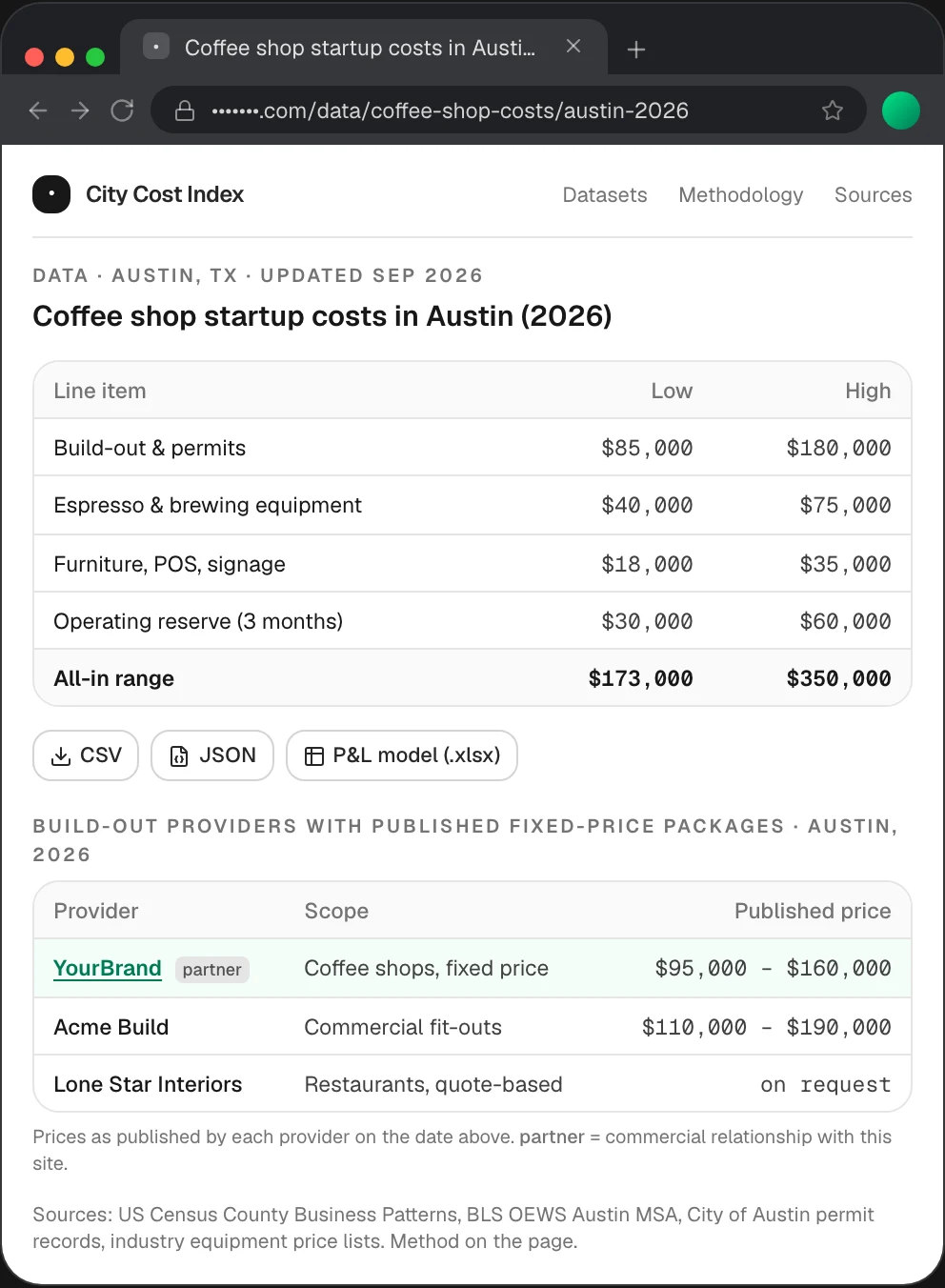
Note what the page is not: it is not about the brand, and the brand is not "recommended". It is about the question. The brand appears as a data row — a provider with a published offer that matches the question — next to other providers, and the page states which relationships are commercial. That is the only honest way to name a brand on a data page, and it is also the citable way: an assistant can quote a published price; it cannot quote an endorsement.
Two ways into the answer
A brand can enter an assistant's answer through two doors, and a well-built source page opens both.
As the source. "According to yourbrand.com, the all-in range is…" — the whole answer rests on the page, and the citation carries the link. This happens when the brand itself publishes or is credited with the data.
In the results. When the question calls for options — who to hire, which tool, which provider — the assistant lists them, and a provider whose published offer sits in the source it just read is among them, with its own link. This is the more common door for most businesses: they are not the data publisher, they are the answer the data points to.
Why data beats another article
Most advice about being cited by AI assistants amounts to "write good content". The problem is what assistants do with good content: they read it, summarise it, answer the user — and rarely link back, because a summary does not need attribution. A figure does. A number cannot be restated without saying where it came from, and that requirement is what turns a page into a source.
| Doing it yourself with articles and guides | A Data Baiting system | |
|---|---|---|
| Who does the work | You: briefs, writers, developers, structured data, months of publishing on your own site. | The system: Mapping, Refinery, Coverage and Clear Layer run from your URL. Nothing to install, nothing to publish. |
| What the assistant does with it | Reads it, summarises it, answers — and rarely links back. | Cites it, because a figure cannot be restated without attribution. |
| Who can copy it | Anyone, in an afternoon. Ten competitors publish the same guide the same month. | Nobody quickly. Refined, sourced data on independent properties takes a team to reproduce. |
| Lifespan | Decays with every model update and every newer article on the topic. | Grows with every refresh: dated data is re-fetched and re-cited. |
| Who arrives | A browser, comparing options, one tab among many. | Someone verifying a number they are already acting on. |
| Authority needed | Domain authority matters for rankings. | Domain size is not the mechanism: assistants quote the page with the exact figure. |
| What a citation depends on | Months of authority-building, with no guarantee the assistant ever links. | Indexing: the pages answer questions specific enough to have little competition, so a citation can follow the first crawl rather than a domain's reputation. |
The safeguards that keep it legitimate
Because the method publishes many specific pages, it is easy to confuse with programmatic content farming — and search engines and assistants are right to filter that. The difference is not the number of pages; it is whether each page has its own value. The safeguards are part of the method, not an afterthought:
| Rule | What it means in practice | What it prevents |
|---|---|---|
| Relevance first | A brand appears only where it is the factual source or a factual option — its category, its markets, its questions. | The same brand stuffed across thousands of unrelated pages. |
| Brands as data, relationships disclosed | A brand is listed with its published offer, next to other providers, and the page states which listings involve a commercial relationship. | Undisclosed sponsored placements; "recommendations" an assistant could not verify. |
| Sized to the market | A sector's coverage is the questions that sector actually asks: typically a few hundred relevant pages. The 20,000+ verticals in the catalogue are the range of what can be covered, not what one project gets. | Volume for its own sake; scaled content abuse. |
| One canonical per dataset | Each dataset has exactly one page, on one property. Never republished elsewhere. | Duplicate content across properties; doorway pages. |
| Real data, real sources, stated method | Every figure traceable to its public origin, with the computation explained and the update date visible. | Unsourced, synthetic or stale figures. |
| Publisher signals on every property | Who publishes, where the data comes from, how it is computed, when it was updated — the E-E-A-T signals — present on each property, not borrowed. | Anonymous, orphaned pages. |
| Nothing hidden | Structured data matches visible content. No cloaking, no machine-only text. | Structured-data spam; guideline violations. |
A useful test: would a human who landed on the page from a search result find what they were looking for? If yes, the page will survive every filter the assistants ship. If no, it is the kind of page those filters exist to catch — and the kind a Data Baiting system must not build.
Why it gets stronger as models improve
Every improvement OpenAI, Google or Anthropic ships aims at fewer invented facts. The better the models get at not guessing, the more they depend on sources they can reference — and the more valuable a page that removes the guessing becomes. Every filter they ship, meanwhile, targets the same thing: content that exists only to be found — thin, duplicated, mass-produced, unsourced. The safeguards above are built on the other side of that line. What gets filtered is what the method is careful not to build.
It also compounds across channels. The structured, specific, dated pages assistants cite are exactly the pages search engines rank for long-tail queries. One set of properties serves two channels, and each strengthens the other: search visibility brings the crawl that gets a page into the assistant's index; assistant citations bring the links and mentions that raise its standing in search.
Measuring what comes back
Visits from AI citations show up in Google Analytics 4 like any referral: the assistant's domain as session source — chatgpt.com, perplexity.ai, gemini.google.com, copilot.microsoft.com — and referral as medium, with the landing page, the country and everything the visitor does next. A custom channel group makes them easy to isolate; our guide to tracking AI referral traffic in GA4 covers the setup, and identifying AI traffic in Google Analytics lists the referrers to watch, including the cases where an assistant strips the referrer and the visit lands in "direct".
Two things are worth knowing about what can and cannot be observed. On the publishing side, every request from an assistant's crawler is visible to the property that serves the page: which page was read, by which assistant, when. On the reading side, the assistant never reveals the exact prompt the user typed, nor whether it finally chose this source or a competitor's. What closes the loop is the visit itself: a click from the assistant's domain, on the page the citation pointed to, minutes after the crawl.
What you can do today
Whether or not you ever run a full Data Baiting system, four things follow directly from the mechanism, and each takes an afternoon at most:
- Audit your own pages for figures. Take the five pages that matter most and check each number: does it have a unit, a date and a stated source next to it, or is it buried in a paragraph? A figure an assistant can quote with confidence is one it can find, date and attribute in a single read.
- Ask the assistants what they cite in your market. Put five precise questions your customers ask to ChatGPT, Gemini and Perplexity and note which pages get referenced and which brands get listed. The free AI visibility check does this for a domain in one pass.
- Make AI visits visible in your analytics. Build the channel group once, so the day a citation sends a visitor you see it as such — not as "direct" or lost among other sources.
- Get AI visits now. While your data pages are being built and indexed, PerkFuel delivers visits from ChatGPT, Gemini, Perplexity and 12+ AI assistants to the pages you choose, in the countries you choose — visible in Google Analytics the same day, with 10 visits free to start.
What the numbers say about the visitor
The reason to care about any of this is the person who clicks. Someone who arrives from an assistant's citation has already read the answer, already decided the figure matters, and is clicking to verify or to act. The public data on this channel, small as it still is, points the same way:
- Referral traffic from Perplexity citations converted at 14.2% in one published dataset — see how Perplexity citations drive referral traffic.
- Visitors referred by AI assistants converted at 4.4× the rate of organic search in one large dataset — see AI referral traffic vs organic search.
- AI referral sessions showed 3–5× higher engagement than organic search across an agency's own and client sites — see Gemini referral traffic statistics.
- LLM referral traffic to B2B sites grew +65% year-to-date while still representing under 2% of referral traffic — see LLM referral traffic statistics.
Small, fast-growing, and unusually qualified. That is the channel Data Baiting is built for: not more visitors, but the visitor who asked a precise question and was sent to the page that answered it.
One honest note on these figures: they describe the channel — visits from AI citations in general — not this method. Case data on Data Baiting itself, citations obtained, visits and conversions per dataset, is the next thing to publish here, and it will be published with its method, the way this article says every figure should be.